Educación no formal

Undefined

Use of technology to teach students with Autism

CienciaPR Contribution: 
No
By: 
Pedro A. Menéndez Sanabria

Teacher Bryan Rivera developed the project Sense around Bakery Club for Autism Learners for students ages 11 and 13 with support form the Department of Education.

To read the full article, visit the Spanish version of this site.

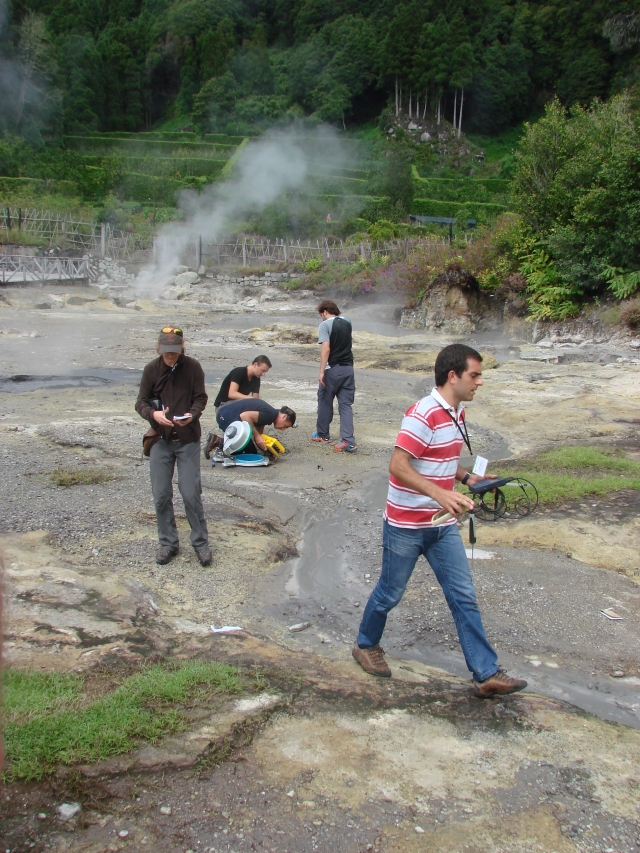
Muestreo interdisciplinario en fumarolas del volcán Furnas

Como consecuencia de nuestro trabajo como cientificos ambientales generalmente vamos al campo con un grupo diverso de científicos. Algunos estudian la química del lugar, otros la geología, la microbiología, etc. Pero generalmetne cuando planeamos estas campañas de campo, pasamos meses de preparación y coordinación; son proyectos que se escriben en conjunto y que cada día, cada muestra, cada posibilidad ya esta bien calculada. 

Lo que hicimos en el Taller  del Deep Carbon Observatory Early Career Scientist, fue algo para mi impresionante. 

The origin of a dengue epidemic

CienciaPR Contribution: 
The Professional is a member of CienciaPR

This article describes the recent article about dengue genetics published in Science by Dr. Mariano García Blanco and his colleagues at Duke University.


To read the full article, visit the Spanish version of this site.
 

The Science article could be found at: http://www.sciencemag.org/content/early/2015/07/01/science.aab3369.abstract


Puerto Rican Luminaries

CienciaPR Contribution: 
No
By: 
Elma Beatriz Rosado

Reproducimos un texto sobre la iniciativa de Casa Pueblo, en la que participa la Universidad de Puerto Rico, para presentar opciones al consumo energético en la isla. Decidimos publicar el escrito en el idioma en que fue redactado originalmente. 

Various efforts are being made to lower Puerto Rico’s energy consumption, and the following story illustrates a vivid one.

Summer biomedical research program for high school and middle school students

CienciaPR Contribution: 
No

The Biomedical Research Education Program (BREP) of the University of Puerto Rico (UPR) Medical Sciences Campus (MSC) held its Annual Biomedical Summer Internships for middle and high school students during the month of June.  Twenty three (24) Middle School students and twenty eight (27) High School students from three different educational districts participated in the internships. 

REU - Reconfigurable and Multifunctional Soft Materials - UPRM

Hello CienciaPR members!

My name is Josh Zak, and I am currently a rising junior at Carnegie Mellon University pursuing a dual degree in Chemistry and Materials Science & Engineering. This summer, I have the distinct privilege of participating in a Research Experience for Undergraduates here at the beautiful University of Puerto Rico - Mayagüez. I am assisting in the research efforts of PhD candidate Heberth Diestra Cruz in the lab of Dr. Aldo Acevedo in the Chemical Engineering department.

Looking at Science and Technology through the eyes of Design

History clearly tells us that science, technology, engineering and mathematics have constantly crossed their paths with art and design. Let’s think about Leonardo Da Vinci in the 15th century, most of his projects showed an equal application of technical and artistic knowledge. After centuries, during which governments addressed their attention to the arts (e.g. kings and popes supporting Michelangelo), the Industrial Revolution, started at the end of the 18th century, moved the attention toward technical disciplines as main tools for economic growth. Therefore, the acronym STEM was coined to refer to four principal disciplines: Science, Technology, Engineering and Mathematics.

Shark that is part of an experiment swims to Puerto Rico

CienciaPR Contribution: 
No
By: 
Pedro Bosque Pérez

A shark that has been monitored was recently track swimming in the south of Puerto Rico. Researchers at Nova Southeastern University’s Guy Harvey Research Institute (GHRI) announced that “St. Mary’s”, shark's name, was escaping the cold temperatures and was swimming in the Caribbean waters.  


El tesoro de una científica rebelde

Aunque su obra fue subestimada, Ana Roqué de Duprey legó uno de los textos más relevantes en la historia de la ciencia de principios del siglo XX en las Américas. Hoy, 90 años después de escribir la ‘Botánica antillana’, una investigación revela el valor del libro inédito.

Así comienza la crónica que el periodista, Eliván Martínez Mercado escribió como producto de su trabajo para el Centro de Periodismo Investigativo. Quedé fascinada desde la primera vez que Eliván compartió esta historia conmigo y cuando ustedes lean esta excelente pieza periodística, seguro sabrán el porqué.


Pages

Subscribe to RSS - Educación no formal