Atmospheric and Terrestrial Sciences

Listening to the whispers from the stars

Wilson Gonzalez-Espada's picture
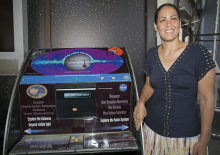
Dr. Wanda Díaz
Dr. Wanda Díaz Merced has created a system that lets her "listen" to the stars (Credit: William Leibman)

Frequently, science teachers ask their students to draw a scientist so that they can get a sense of what students think and imagine about scientists. Thousands and thousands of drawings show the same stereotypical characteristics: a male scientist, white, dressed in a lab coat, usually a chemist mixing liquids and generating explosions, and a person that does not have any physical limitations. 

No student has ever drawn a scientist like Dr. Wanda Díaz Merced.  This young woman from Gurabo embodies the scientific anti-stereotype. Not only is she a woman and Puerto Rican, but also she completed her doctoral work in astrophysics, and without being able to use her sight.

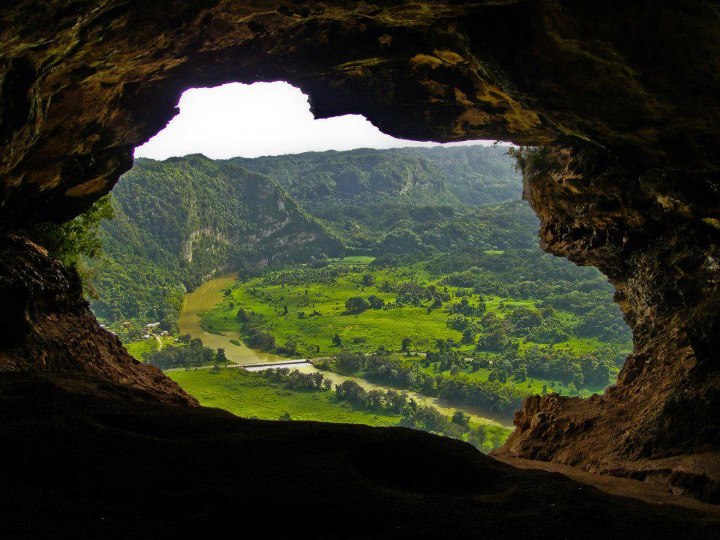
Las Cabachuelas, an underground treasure

This article is reproduced by CienciaPR with permission from the original source.

CienciaPR Contribution: 

No

By: 

Aurora Rivera Arguinzoni / arivera@elnuevodia.com

In 2012, Las Cabachuelas cave system was designated as a natural reserve. Unfortunately, the money destined to promote its conservation its being used for other purposes, putting this important ecosystem at risk.


The original version of this article in Spanish. You can access it by clicking on ESPAÑOL at the top right of your screen. You can also contact our editor Mónica I. Feliú-Mójer (moefeliu@cienciapr.org).

Tags: 

20th anniversary of a Nobel Prize, made in Puerto Rico

This article is reproduced by CienciaPR with permission from the original source.

CienciaPR Contribution: 

The Professional is a member of CienciaPR

What do Albert Einstein and the Arecibo Observatory have in common? Twenty-years ago Joseph Taylor and Russell Hulse won a Nobel Prize for their discovery of pulsars, using the Arecibo Observatory to detect these binary stars. This discovery offered evidence of Einstein's theory of relativity.


The original version of this article is in Spanish. You can access it by clicking on ESPAÑOL at the top right of the screen. You can also contact our editor Mónica Feliú-Mójer (moefeliu@cienciapr.org).

Tags: 

20th anniversary of a Nobel Prize, made in Puerto Rico

This article is reproduced by CienciaPR with permission from the original source.

CienciaPR Contribution: 

The Professional is a member of CienciaPR

In 1975, Dr. Joseph Taylor and his graduate student Russell Hulse discovered pulsars using the Arecibo Radiotelescope. In 1993 they won a Nobel Prize in Physics for that discovery, which helped confirm Einstein's theory of relativity.


The original version of this article is in Spanish. You can access it by clicking on ESPAÑOL at the top right of your screen. You can also contact our editor Mónica I. Feliú-Mójer (moefeliu@cienciapr.org).

Tags: 

When technology goes too far

This article is reproduced by CienciaPR with permission from the original source.

CienciaPR Contribution: 

The Professional is a member of CienciaPR

In this article, part of our collaboration with El Nuevo Día, Wilson González Espada explains what happens when technology jumps ahead of science and launches products that have not been tested for safety. Some examples include X-rays, the pigment green of Paris, radioactive materials sold as energy boosters and recently, some pain medications that ended up having adverse cardiovascular effects.

Tags: 

Pages

Subscribe to RSS - Atmospheric and Terrestrial Sciences